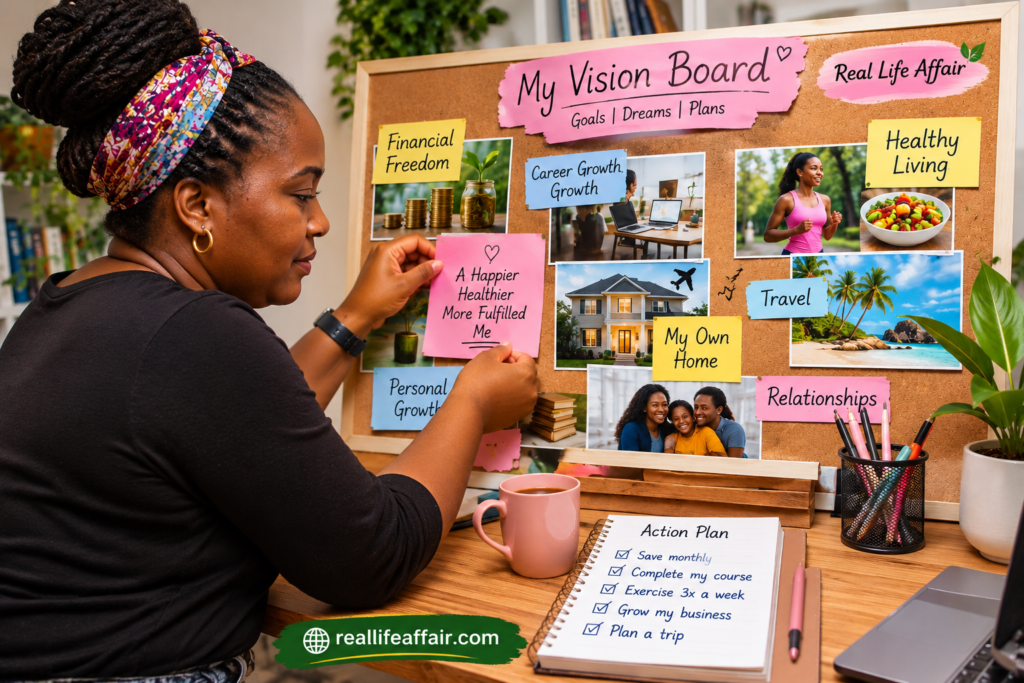

Learning how to create a vision board starts with being honest about what you want your life to look like. A vision board is a collection of pictures, words, quotes, and reminders that represent the things you hope to achieve. It gives you something you can look at regularly to remind yourself of your goals and the direction you want to take.
Maybe you have been thinking about starting a business, changing careers, improving your finances, travelling, getting healthier, or building better relationships. You have all these things in your mind, but when someone asks you exactly what you want to achieve, you struggle to put everything together.
A vision board can help you bring those thoughts into one place.
However, don’t make the mistake of thinking that creating a beautiful board is the same as making progress. Finding pictures of a dream house, a successful business, or a beautiful holiday destination will not automatically bring those things into your life. The real value comes from knowing why you chose those goals and what you are prepared to do to work towards them.
Here are seven practical steps to help you create a personal vision board that reflects what you genuinely want, rather than simply copying what looks attractive online.
1. Take Time to Understand What You Really Want
Before looking for pictures or buying materials, sit down and think about the kind of life you want to build.
This is important because it is easy to fill a vision board with things you have seen other people achieve. You see someone travelling, buying a house, getting married, or running a successful business, and suddenly those things become part of your own goals. But have you taken time to decide whether they are genuinely important to you?
Start by looking at different areas of your life. Think about your finances, career, health, relationships, personal growth, and lifestyle.
You can use these questions to get started:
- What would I like to change about my current financial situation?
- What kind of work or business do I want to build?
- How do I really want to feel about my health and daily routine?
- What kind of relationships do I want to maintain?
- What skills or personal qualities do I want to develop?
- What experience have I always wanted to have?
Don’t rush to answer everything. Write down what comes to mind and give yourself time to separate what you genuinely want from what you feel pressured to achieve.
2. Choose the Goals You Want to Focus On
Once you have written down your ideas, decide which ones deserve a place on your vision board.
You may have twenty things you want to achieve, but trying to put everything on one board can make it confusing. Choose the goals that matter most to you at this stage of your life.
For example, you might organize them like this:
| Area of life | What you want to achieve |
| Finances | Build savings and become more financially stable |
| Career | Learn a valuable skill or secure a better job |
| Business | Start a business that attracts real customers |
| Health | Exercise regularly to improve your health and eating habits |
| Relationships | Build healthier connections but also maintain boundaries |
| Personal growth | Become more confident and disciplined |
| Lifestyle | Travel to a place you have always wanted to visit |
These are only examples. Your own goals may be completely different, and that’s fine.
Try to be specific. Instead of writing “I want more money,” you could write “I want to save ₦1 million by December.” Instead of “I want a better career,” identify the type of job, skill, or professional opportunity you are working towards.
The clearer your goals are, the easier it becomes to decide what belongs on your vision board.
3. Decide Whether You Want a Physical or Digital Vision Board
You don’t need expensive materials to create a good vision board. What matters is choosing a format you can easily update and look at regularly.
A physical vision board is made using materials such as cardboard, printed photographs, magazines, scissors, glue, and markers. Your digital vision board can be created using tools such as Canva or a simple presentation document on your computer.
Both options work. Choose the one that fits your lifestyle.
| Physical vision board | Digital vision board |
| Made with printed pictures and paper | Created using digital pictures and text |
| Can be placed on a bedroom or office wall | Can be saved on your phone or computer |
| Easy to see without opening an app | Easy to update whenever your goals change |
| Requires basic craft materials | Can be created using free design tools |
| Gives you something you can physically arrange | Makes it easy to collect and organize images |
If you spend most of your day working on a computer, a digital board may be convenient. If you prefer something you can see whenever you enter your room, a physical board may be better.
You can also create both, provided you don’t turn the process into an unnecessary expense.
4. Find Pictures and Words That Represent Your Goals
This is where your vision board begins to take shape.
Look for pictures that represent what you want to achieve. If your goal is to start a business, you might use an image of a well-organized workspace, a product you want to develop, or a successful business environment.
If you want to improve your health, choose pictures that represent the kind of healthy routine you want to build. For a travel goal, use an image of the actual destination you hope to visit.
You can also include words and short statements that remind you of what you are working towards, such as:
- Financial stability
- Better health
- Consistency
- Personal growth
- Career development
- Peace of mind
- A successful business
Be more selective with your images. You don’t need ten pictures of expensive houses or luxury cars if your actual goal is to become financially independent.
Choose images that mean something to you, not just pictures that make the board look impressive.
5. Arrange Your Vision Board in a Way That Makes Sense to You
Once you have gathered your pictures and words, start arranging them.
You can divide your board into sections based on different areas of your life. For example, put your career and business goals together, your financial goals in another section, and your health and personal development goals somewhere else.
You could also place your most important goal near the centre so it is easy to notice.
Here is a simple illustration of how you might arrange a personal vision board:
| Finances | Career and Business |
| Savings goals, debt reduction, financial stability | New skills, business ideas, career opportunities |
| Personal Vision | |
| Health and Lifestyle | Relationships and Personal Growth |
| Exercise, healthy habits, travel experiences | Better connections, confidence, self-discipline |
This is only one arrangement. You can organize your board differently depending on your goals.
Don’t spend so much time trying to make everything look perfect that you forget why you started. Your vision board should be meaningful and easy to understand, not necessarily something that belongs in a design competition.
6. Turn Every Important Picture Into an Action Plan
This is probably the most important part of creating a vision board.
You can put a picture of a beautiful house on your board, but what are you doing to move towards owning one? You can add an image of a successful business, but have you started researching the market, learning the necessary skills, or saving towards your first investment?
A vision board becomes more useful when you connect the things you want with practical steps you can take.
For every major goal, write down at least one action that moves you closer to it.
| Vision board goal | Practical action |
| Start a business | Research the market properly and identify your first product or service |
| Save money | Create a monthly budget and set a realistic savings target |
| Improve your health | Schedule regular exercise and plan healthier meals |
| Learn a new skill | Choose a course and set aside time to practise |
| Travel abroad | Research the destination and calculate the likely expenses |
| Build better relationships | Make time for meaningful conversations and healthier boundaries |
You don’t have to complete everything at once. Start with the actions you can realistically take now and build from there.
If you want to learn more about building a meaningful life while working towards goals you haven’t achieved yet, take a look at 9 Ways to Build a Meaningful Life Even When You Don’t Have Everything Figured Out. It offers a useful perspective on making progress without waiting for every part of your life to fall into place.
7. Review Your Vision Board and Make Changes When Necessary
Your vision board should not become something you create once, hang on a wall, and forget about.
Make time to look at it regularly. You could review it every week or set aside time at the end of each month to check your progress.
Ask yourself whether you have taken any steps towards your goals, what is working, and what needs to change. You may discover that some goals are no longer important to you, while other priorities have become more urgent.
That doesn’t mean you have failed. Your interests, responsibilities, and circumstances can change as you grow.
For example, you may have created a vision board focused on starting a business, but later realize that you need to spend more time developing your skills and building some savings first. You can adjust your plan without abandoning the bigger goal.
If you are still trying to understand your direction in life, How Do You Know If You Have a Unique Assignment in Life? is another related article worth exploring. It encourages you to think more carefully about your interests, abilities, and the kind of contribution you want to make.
How to Keep Your Vision Board Connected to Your Everyday Life
Creating your vision board is one thing; remembering to use it is another. If you want it to remain useful, connect it to your normal routine.
Here is a simple weekly approach:
| When | What to do |
| Monday | Look at your goals and choose your main priorities for the week |
| Wednesday | Check whether you are making progress on your planned actions |
| Friday | Reflect on what you managed to accomplish |
| Sunday | Review the week and decide what needs attention next |
You don’t need to spend hours staring at your vision board every day. A few minutes of reflection can be enough to remind you what you are working towards.
Three Books to Explore
Sometimes, creating a vision board brings up bigger questions about your direction, your fears, and what you genuinely want from life. These books may help you reflect more deeply.
THE HIDDEN DESIGN OF YOUR LIFE is worth exploring if you have several dreams but still struggle to decide which direction to take. It speaks to the uncertainty many people experience when trying to figure out their next step.
It is available at a special discounted rate from the Real Life Affair Shop.
If fear has been stopping you from pursuing the goals you keep writing down, What Will People Think? is another book to consider. It offers an opportunity to examine the doubts that make you hesitate when it is time to take action.
You can get it at a special discounted rate from the Real Life Affair Shop.
And if you want to reflect on how your experiences, decisions, and circumstances connect with the direction your life is taking, THE CHOSEN ONE may also interest you.
It is available at a special discounted rate from the Real Life Affair Shop.
Conclusion
A vision board is more than just putting nice pictures together. It’s a way to remind yourself of the things you want to achieve and keep your mind on what you’re working towards.
You don’t have to know exactly how your future will turn out before you create one. Start with the things you want right now, choose the goals that mean something to you, and think about what you can do to make them happen.
Some goals will take longer than you expect, and there may be times when what you want changes. That’s perfectly normal. Review your board from time to time, make changes as your life moves forward, and most importantly, don’t just look at the pictures every day without doing anything about them. Take small steps towards the life you want.